Have any questions? Start a conversation with our team.
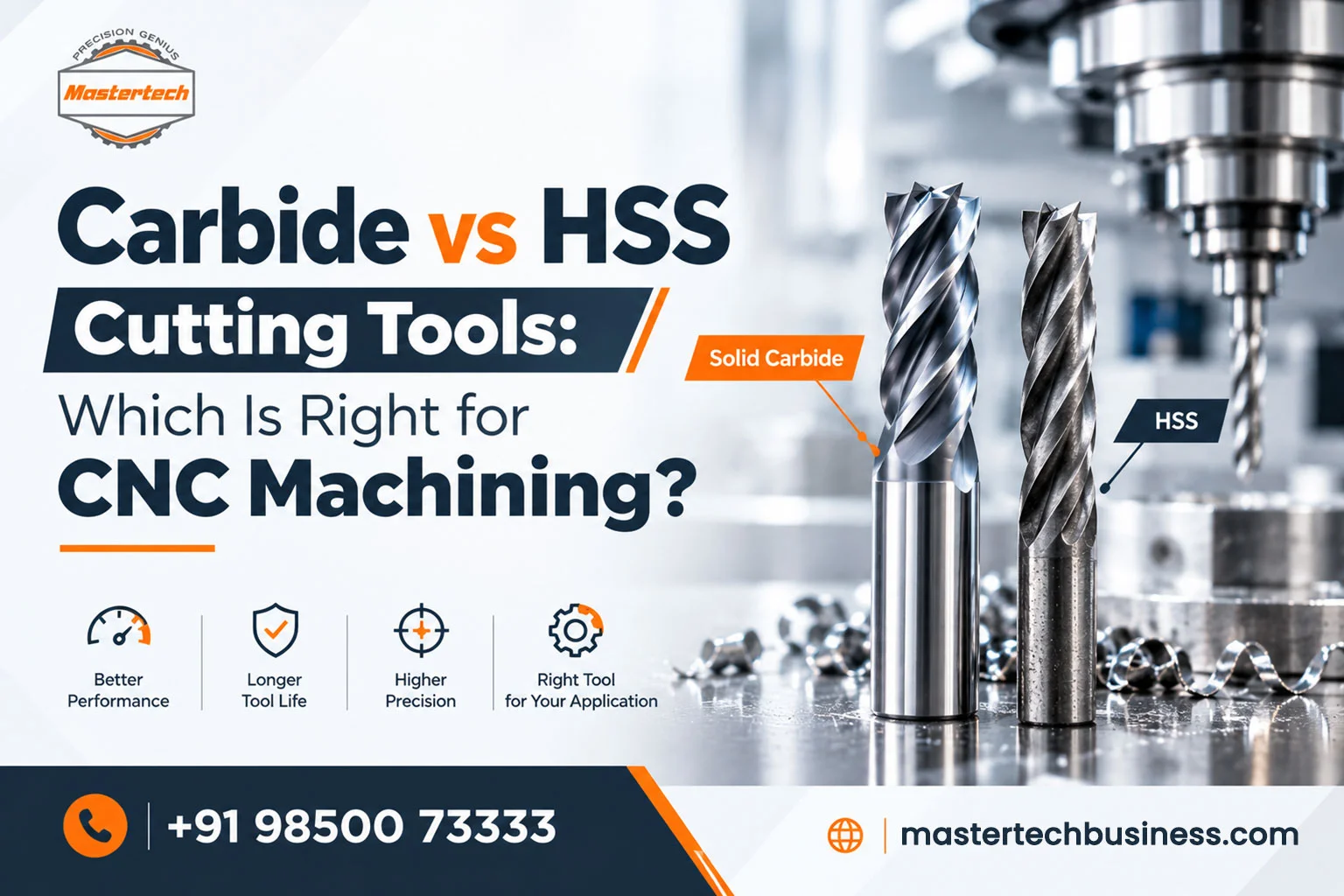
Choosing between solid carbide and high-speed steel (HSS) is one of the first decisions in any CNC machining job. It affects accuracy, cutting speed, tool life and overall production efficiency. Solid carbide is not automatically the best choice for every operation, and HSS is not just a leftover from older workshops. Each suits particular machines, materials and production needs.
At Mastertech, a cutting tools manufacturer in Pune, we are asked about this often. This guide explains how the two materials differ, where each performs best, and how to decide using your own machine, material and batch size. It also shows when the solid carbide tools we manufacture make the biggest difference, and when they do not.
Tungsten carbide grains held together by a metallic binder, usually cobalt, then ground to shape.
An alloy tool steel designed to keep its hardness at elevated cutting temperatures.
| Factor | Solid Carbide | HSS |
|---|---|---|
| Hardness | Very high | Lower than carbide |
| Stiffness | High (resists deflection) | Lower than carbide |
| Wear resistance | Generally excellent | Depends on grade and application |
| Typical cutting speed | Often 2 to 4 times higher | Lower |
| Toughness | More sensitive to impact | More forgiving |
| Resharpening | Needs specialised grinding | Often easier with standard equipment |
| Best suited to | High-performance CNC machining | General-purpose, moderate-speed machining |
Figures are typical ranges for guidance. Actual results depend on grade, geometry, workpiece material, machine condition and cutting parameters.
In short, carbide offers speed and rigidity, while HSS offers toughness and operating flexibility.
Hardness gets the attention, but stiffness often has the bigger effect on a CNC machine. Solid carbide has a much higher elastic modulus than HSS, so it deflects less under load. That helps with straighter walls, accurate hole positions, better finish and less chatter, especially in small diameters and long reaches.
A stiff tool cannot make up for a weak setup, though. Excessive runout, long overhang, a worn spindle or poor clamping can still cause vibration, poor finish and edge damage. Before moving to carbide, check the whole system: spindle, holder, workholding and machine rigidity.
This is where most tool decisions are really made. Use this as a starting point, then confirm with your supplier.
| Workpiece Material | Solid Carbide | HSS |
|---|---|---|
| Aluminium | Well suited for CNC work, usually with geometry designed for aluminium and good chip space | Workable at low volume, but chip sticking can be an issue |
| Mild steel / EN-series steel | Good for production runs on CNC | Fine for manual machines and small batches |
| Stainless steel | Preferred on rigid CNC setups, as it handles heat and work hardening better | Possible at low speeds, but wears quickly |
| Cast iron | Good, since abrasive wear is better resisted | Wears faster |
| Hardened steel | Generally the only practical option, with a suitable grade and coating | Not recommended |
| Titanium and heat-resistant alloys | Preferred, with a rigid setup and good coolant | Very limited tool life |
| Brass, plastics | Works well | Works well, and is often the practical choice |
Higher cutting speed and longer edge life mean more parts per shift and fewer tool changes.
Stainless steel, tool steel, cast iron and hardened alloys generate heat and wear that carbide handles better.
Die and mould work, narrow slots and detailed contours benefit from carbide's stiffness.
Thin ribs, narrow slots and precision bores are more repeatable with a stiffer tool.
If you buy milling tools regularly, work with an end mills manufacturer in Pune or elsewhere in India who can recommend the geometry and grade for your material. The same applies to hole making. A good carbide drills manufacturer in Pune will ask about hole depth, coolant and tolerance before suggesting a drill.
Send us your material, drawing and quantity. Mastertech's tooling engineers in Pune will suggest a suitable tool.
A tool that looks more expensive upfront is not always the more expensive choice. What matters is the total cost of each good part, which includes tool cost, machine time, tool changes and rejected parts.
Here is a simple illustrative comparison for 1,000 stainless steel components on one end mill operation. The figures are examples only.
| HSS End Mill | Solid Carbide End Mill | |
|---|---|---|
| Cycle time per part | 4.0 minutes | 1.8 minutes |
| Parts per tool | 150 | 600 |
| Tools needed for 1,000 parts | ~7 | ~2 |
| Tool changes during the batch | ~7 | ~2 |
| Machine time for the batch | ~67 hours | ~30 hours |
Illustrative example only. Real results depend on your machine, material, parameters and tool grade.
In this example, carbide needs far fewer tool changes and frees up about 37 machine hours. On a production machine, that saved time usually matters more than the difference in tool cost.
Now take a different job: 20 parts in mild steel on a manual machine. The cycle time barely changes, tool life is not a concern, and HSS becomes the practical choice. For long production runs on rigid CNC machines, carbide tends to win on total cost per part. For short runs on slower machines, HSS often does.
| Your Situation | Better Choice |
|---|---|
| CNC machining centre, production batches | Solid carbide |
| Stainless, hardened steel, titanium, cast iron | Solid carbide |
| Tight tolerance and fine finish | Solid carbide |
| Manual or low-RPM machine | HSS |
| Interrupted cuts, flexible setup | HSS, or a tougher carbide grade with suitable geometry |
| Soft material, small quantity | HSS |
| Prototype or one-off job | HSS |
Whichever material you choose, results depend on carbide quality, grinding accuracy and geometry consistency. When comparing a solid carbide tools manufacturer in India, ask which carbide grade is used, how each batch is inspected, and whether custom geometries can be made from your drawing.
Mastertech is ISO 9001:2015 certified. Our tools are ground on 5-axis CNC machines from premium German carbide rods, and we supply automotive, aerospace, defence and die-and-mould customers across India.
The right answer is not "carbide" or "HSS". It is whichever lowers your cost per good part on your machine, with your material and your batch size. Rigid CNC machines, harder materials and tight tolerances usually favour solid carbide. Older machines, soft materials and one-off jobs often favour HSS.
If you are looking for a CNC cutting tools manufacturer in Pune or anywhere in India who can advise on the material as well as supply the tool, explore our CNC cutting tools range. You can also send us your material, drawing and quantity, and our tooling engineers will suggest a suitable tool. Get a quote or call +91 9850073333.
Send us your material, drawing and quantity, and our tooling engineers will suggest a suitable tool.
